
Saturday, September 28, 2013

Monday, September 23, 2013

Friday, September 6, 2013
My Church History
I was always aware of plural marriage and I knew that
Joseph had practised it. But when I first began to study the details, it
was by way of [an inadequately researched book that made startling claims], and I almost immediately encountered . . . [troubling] claims. . . . And I stopped at that point
because I hadn’t done the legwork to [know the whole story]. The author dumped it on me and he moved on and I had to decide what to
do with it, and many of you or most of you have perhaps had that
experience of kind of bopping along blissfully, and then someone
presents you with some stuff and just kind of leaves you to deal with
it. And that’s why plural marriage is such a useful tool for the antis
is because they don’t have to do much.
So, I thought about it a lot. And I didn’t know much but I knew three things.
- I knew that I didn’t know enough to answer the questions that this was going to bring up.
- I knew that finding the answers, if there were any, was going to take a lot of time and a lot of work.
- I knew that I might not be intellectually or spiritually up to the challenge of finding those answers or recognising the answers or being satisfied with the answers. And I knew that answers might not exist.
So, I determined then to take that to the Lord and it
was one of the most interesting experiences of my life. The scriptures
talk about having the Spirit give you words—give you words to pray when
you don’t know what you should say (e.g., Romans 8:26, 3 Nephi 19:24).
Well, I thought I knew what I was going to say, but apparently that
wasn’t what I was supposed to say, so I ended up saying something quite
different from what I knelt down intending to talk about. Somewhat to my
surprise, I found myself telling my Father in Heaven what bothered me
and instead of begging him for answers or insisting upon them (as I had
half planed to do) I found myself telling him that I would not forsake
him, that I would not forsake our relationship, that I was not going to
turn my back on it or on him. And, that I was not going to abandon my
covenants. I told him that come what may, I would do whatever he wanted
me to do. And then, I asked him if it would be spiritually dangerous for
me to commit the kind of time and energy and effort and intellectual
work that this project would probably require.
And I thought that that was going to be the first of
many struggling prayers over the issue. But God is gracious and he told
me very clearly that I was quite free to investigate it, that it would
all work out, though he gave me no idea of how or in what way, and that I
had nothing to worry about. And here I am, four years later, talking
about it—you must be careful what you ask for, you may get it. I almost
think he was a little bit unfair! If I had known this was part of the
deal—I did not bargain for this. I did not set out to be the person
people ask about plural marriage. Anyone out there who wants the title
can see me after.
But, as I’ve thought about that experience--and I think you picked that up very well in this quite heartrending letter that I’ve been reading from here—even the idea
of plural marriage is deeply hurtful for some people, especially women.
And it’s more, I’m convinced, than just some kind of social or cultural
revulsion. I think sometimes it’s speaks to the things that we have
experienced in our lives. It brings up memories of the abusive power or
of men who mistreated us or sexual abuse or inconsiderate spouses or a
host of other things. And it also is easily made to seem a textbook
example of the abuse of religion for power—the preacher who wants sex
with you and your daughter in exchange for salvation. And I sympathise
with all those reactions because I know something of them.
But, perhaps, because of them or in my case, because of
the vastness of the topic, we become very uneasy, in a way, with plural
marriage that I don’t see with other apologetic issues. We feel a
pressure and urgency to solve this problem above all others, once and
for all, and quickly. The more we look, the harder it seems to solve it.
In large part because the usual sources that we have to rely on, as I
have shown you, do very little to help us solve it. And without the
primary sources we are, in a sense, lost. And the cycle is thus a
vicious one because the more we try to solve it, the more it gets dumped
on us.
Now, I am not—before some mouth-breather on the internet concludes otherwise—I am not suggesting that we stop thinking or that I think thinking is a bad idea.
But, the problem was, in that moment, when I first
approached God with this, was that my spiritual life did not have four
or five years, which is how long I’ve been doing this now, to sit in the
church archives. My spiritual life could not be put on hold for that
long. How long could I halt between two opinions? If Joseph be Baal or a
sexual predator, don’t follow him. Jesus called the apostles and did
not tell them to spend three or four years with the primary sources
before deciding to answer the call to “Come, follow me.”
And for me, ultimately, the question (I see now) had
nothing to do with plural marriage at all. Plural marriage was only the
catalyst for a much more fundamental question and that question was, “Do
I trust Father?” And I see now, by the grace of God, that my
instinctive reaction was to do that, to express my trust and, amazingly,
to mean it. I did not realise it at the time, but what I effectively
chose to do, if I can put it crudely, is I chose to “consecrate my
brain.” I value my brain—we all do—nobody likes to be thought foolish or
naaive or ill-informed or duped or cognitively dissonant or any of the
other labels people can put upon us.
I’m a doctor, I’m regarded as a reasonably smart person, I love
science, I love evidence, I’m a sceptic, I’m a rationalist. I say all
this about myself—I am all those things, that’s part of how I conceive
of myself.
I could have gone before God and I could have demanded
answers, I could’ve told him I want the evidence and I want it now, I
want closure. I could’ve issued him ultimatums. I could’ve told him that
if this didn’t work out, I was quitting. But, I chose instead, to
consecrate my brain. I was willing to sacrifice my self-image, my years
of learning, my intellectual effort and my social respectability on the
internet (which I’m sure is crashing as I speak!) because I trusted
Father.
But, you know, it’s the funny thing about consecration,
you always get back everything you consecrate, with interest. Once my
Father and I had an understanding which took, maybe, 10 minutes, I was
back to thinking again. And immediately, I began to get more answers and
perspective that I know what to do with, and it hasn’t stopped yet.
It’s like trying to drink from a fire hose and I apologize for spraying
you all but I haven’t exactly got it controlled yet.
I got “good measure, pressed down, and shaken together,
and running over” (Luke 6:38). I cast my bread upon the water and God
sent back an aircraft carrier with a bakery on top.
My only fear in saying all this is that some people will
think I’m offering a pat answer—I’m not. Abraham was asked to
consecrate Isaac. And with Isaac went all the precious promises,
everything that made Abraham, Abraham. But he put his son on the altar
and he got him back and so much more. We know how Abraham’s story ends
but Abraham did not. And as Elder Maxwell observed, even when we know
it’s a test, we can’t say, “Look ma, no hands.”
You can’t consecrate your brain while crossing your fingers and hoping
that we can somehow trick God by going through the intellectual motions
and that he will support our demand for proof. You can’t ask for a sign,
but I bear you my witness that “signs follow them that believe,” in
this as in everything (D&C 63:9).
And so, I’ve tried to answer some questions today but I
will leave you with one. And that question is, “Do you trust Father?” If
you do, I have no worries, and if you do not, or if you’ve forgotten
how, or you fear you may be starting to, you must start there because no
answer from me or anyone else will satisfy you on a historical matter.
And if plural marriage doesn’t trip you up, something will. Settle it up
with Father and then you and I can talk.
Praise be to the man who communed with Jehovah. I will
not bear you testimony of the history I’ve told you for that could all
change tomorrow. But I bear witness of the Lord of the outstretched arm,
who comes into our nights and into our days and clasps us to his chest,
and who gives us back a hundredfold of all the poor leavings that we
drop upon the altar—sometimes with clenched fists and worried backward
glances, since we really didn’t want to give it up—that we drop upon the
altar which is already stained with his far more impressive sacrifice
on our behalf.
--Greg Smith (slightly edited)

Saturday, August 10, 2013

Leon Wieseltier praised the tradition of the liberal arts, which were founded on leisure and contemplation. He told the graduates of Brandeis that the new “information era” came with dangerous consequences:
In the digital universe, knowledge is
reduced to the status of information. Who will any longer remember that
knowledge is to information as art is to kitsch—that information is
the most inferior kind of knowledge, because it is the most external? A
great Jewish thinker of the early Middle Ages wondered why God, if he
wanted us to know the truth about everything, did not simply tell us
the truth about everything. His wise answer was that if we were merely
told what we need to know, we would not, strictly speaking, know it.
Knowledge can be acquired only over time and only by method.
Wieseltier concludes by saying: “Perhaps culture is now the counterculture.”--Gergory Wolfe
Monday, July 1, 2013
.
On subjects of which we know nothing, we both believe and disbelieve a hundred times an hour, which keeps believing nimble.
 — Emily Dickinson

Monday, June 24, 2013
But Then It Was Too Late

"They Thought They Were Free--The Germans, 1933-45," Milton Mayer
Sunday, June 9, 2013
On Doing the Right Thing
“When faced with the prospect that we might have to give up some sin we have come to cherish dearly, we often say something like ‘I would rather die’” We’d rather die, it seems, because we see having our entire world collapse definitively as an easier task than the work of slowly reconstructing the world in fidelity to the call to repentance. Because life is work (the work to which grace spurs us), we’d rather give up our whole world than repent. But, as Jim [Faulconer] further notes, this is only because we don’t realize how much work we’re already doing in trying to keep our sinful world intact. We cherish a certain sort of work, the work of misery, and don’t want to give it up for a rather different kind of work. As Jim says: “One of the reasons God’s grace is required to save us is that when we are sinners, we cannot see life and death truly; we have distorted our vision so that life seems like death and death seems like life.”
--Joe Spencer on Jim Faulconer's "Life of Holiness"
--Joe Spencer on Jim Faulconer's "Life of Holiness"
Friday, June 7, 2013
On Doing the Right Thing
Once, I remember, I ran across the case of a boy who had been sentenced to prison, a poor, scared little brat, who had intended something no worse than mischief, and it turned out to be a crime. The judge said he disliked to sentence the lad; it seemed the wrong thing to do; but the law left him no option. I was struck by this. The judge, then, was doing something as an official that he would not dream of doing as a man; and he could do it without any sense of responsibility, or discomfort, simply because he was acting as an official and not as a man. On this principle of action, it seemed to me that one could commit almost any kind of crime without getting into trouble with one’s conscience. Clearly, a great crime had been committed against this boy; yet nobody who had had a hand in it—the judge, the jury, the prosecutor, the complaining witness, the policemen and jailers—felt any responsibility about it, because they were not acting as men, but as officials. Clearly, too, the public did not regard them as criminals, but rather as upright and conscientious men.
The idea came to me then, vaguely but unmistakably, that if the primary intention of government was not to abolish crime but merely to monopolize crime, no better device could be found for doing it than the inculcation of precisely this frame of mind in the officials and in the public; for the effect of this was to exempt both from any allegiance to those sanctions of humanity or decency which anyone of either class, acting as an individual, would have felt himself bound to respect—nay, would have wished to respect.
--Albert J. Nock's, "Anarchist's Progress"

The idea came to me then, vaguely but unmistakably, that if the primary intention of government was not to abolish crime but merely to monopolize crime, no better device could be found for doing it than the inculcation of precisely this frame of mind in the officials and in the public; for the effect of this was to exempt both from any allegiance to those sanctions of humanity or decency which anyone of either class, acting as an individual, would have felt himself bound to respect—nay, would have wished to respect.
--Albert J. Nock's, "Anarchist's Progress"

Tuesday, April 23, 2013
Kofa Mt., Arizona

― Ralph Waldo Emerson,
Monday, April 15, 2013
One Art, by Elizabeth Bishop

so many things seem filled with the intent
to be lost that their loss is no disaster.
Lose something every day. Accept the fluster
of lost door keys, the hour badly spent.
The art of losing isn't hard to master.
Then practice losing farther, losing faster:
places, and names, and where it was you meant
to travel. None of these will bring disaster.
I lost my mother's watch. And look! my last, or
next-to-last, of three loved houses went.
The art of losing isn't hard to master.
I lost two cities, lovely ones. And, vaster,
some realms I owned, two rivers, a continent.
I miss them, but it wasn't a disaster.
—Even losing you (the joking voice, a gesture
I love) I shan't have lied. It's evident
the art of losing's not too hard to master
though it may look like (Write it!) like disaster.
Saturday, April 13, 2013
Primer on Mormon Prayer, by Adam Miller
A religious life is a life of prayer. Don’t skimp on this or, no matter how white your sepulcher, your insides will always just be full of dry bones.
How to pray:
1. Pray for at least twenty minutes, at least once a day, preferably in the morning.
2. Sit with your back straight, your hands nested in your lap, and your head only slightly bowed.
3. Aim for a 10-to-1 ration of listening to yammering. Given twenty minutes, say what you have to say in the first two minutes, then shut up and listen.
4. The Spirit can speak in all kinds of ways, but take as your baseline the classic Mormon expectation that the Spirit will manifest in your bosom or gut. Physiologically, direct you attention to the area just behind and below your navel. Simply attend, without interruption, to whatever bodily sensations show up there. Direct your attention to that single spot in waiting and expectation. This is what it means to “watch in prayer.”
5. Whenever your attention wanders – which it will do regularly, consistently, and almost immediately – note without judgment whatever you were daydreaming about (“Thinking about lunch-plans.” Or, “Thinking about the inconsiderate thing my husband did.”) and then, without elaboration, bring your attention firmly back to your gut and continue listening for the Spirit. You’ll get better with practice. But, in the meanwhile, you’ll also get a master-class in the content and extent of your own fallen, distracted, and profoundly self-absorbed nature.
6. The most obvious manifestations of Spirit include the following feelings in your bosom. Watch, in particular, for these: (1) warmth, (2) the rise and fall of your diaphragm in connection with the breath of life, (3) a spreading stillness, (4) a recession of your need, like the tide going out, to compulsively impose your will on the course of the day and on the people you’ll meet, (5) a willingness to, in general, pay attention and serve, and (6) the distinct impression that you are, in fact, regardless of circumstance, alive.
7. Learn how to pay attention to the Spirit in this same way throughout the day, as often as your able, whatever you’re doing. This is called “praying always.” The extension of this attentive, prayerful listening into the business of your daily life is the sum and substance of “conversion.”

How to pray:
1. Pray for at least twenty minutes, at least once a day, preferably in the morning.
2. Sit with your back straight, your hands nested in your lap, and your head only slightly bowed.
3. Aim for a 10-to-1 ration of listening to yammering. Given twenty minutes, say what you have to say in the first two minutes, then shut up and listen.
4. The Spirit can speak in all kinds of ways, but take as your baseline the classic Mormon expectation that the Spirit will manifest in your bosom or gut. Physiologically, direct you attention to the area just behind and below your navel. Simply attend, without interruption, to whatever bodily sensations show up there. Direct your attention to that single spot in waiting and expectation. This is what it means to “watch in prayer.”
5. Whenever your attention wanders – which it will do regularly, consistently, and almost immediately – note without judgment whatever you were daydreaming about (“Thinking about lunch-plans.” Or, “Thinking about the inconsiderate thing my husband did.”) and then, without elaboration, bring your attention firmly back to your gut and continue listening for the Spirit. You’ll get better with practice. But, in the meanwhile, you’ll also get a master-class in the content and extent of your own fallen, distracted, and profoundly self-absorbed nature.
6. The most obvious manifestations of Spirit include the following feelings in your bosom. Watch, in particular, for these: (1) warmth, (2) the rise and fall of your diaphragm in connection with the breath of life, (3) a spreading stillness, (4) a recession of your need, like the tide going out, to compulsively impose your will on the course of the day and on the people you’ll meet, (5) a willingness to, in general, pay attention and serve, and (6) the distinct impression that you are, in fact, regardless of circumstance, alive.
7. Learn how to pay attention to the Spirit in this same way throughout the day, as often as your able, whatever you’re doing. This is called “praying always.” The extension of this attentive, prayerful listening into the business of your daily life is the sum and substance of “conversion.”

met t' know ya

N.T. Wright
Monday, April 1, 2013
hey, like, whatever

It was a “kick in the guts,” Richards says. It transformed him in ways with obvious political ramifications:
Richards may have been predisposed by his personality to become a liberal, but his politics were not predestined. Had his teachers treated him differently–or had he simply interpreted events differently when creating early drafts of his narrative–he could have ended up in a more conventional job surrounded by conservative colleagues and sharing their moral matrix. But once Richards came to understand himself as a crusader against abusive authority, there was no way he was ever going to vote for the British Conservative Party. His own life narrative just fit too well with the stories that all parties on the left tell in one form or another.The moment that happened, Spike, Terry and I, we became terrorists. I was so mad, I had a burning desire for revenge. I had reason then to bring down this country and everything it stood far. I spent the next three years trying to [mess] them up. If you want to breed a rebel, that’s the way to do it… It still hasn’t gone out, the fire. That’s when I started to look at the world in a different way, not their way anymore. That’s when I realized that there’s bigger bullies than just bullies. There’s them, the authorities. And a slow-burning fuse was lit.
Sunday, March 31, 2013
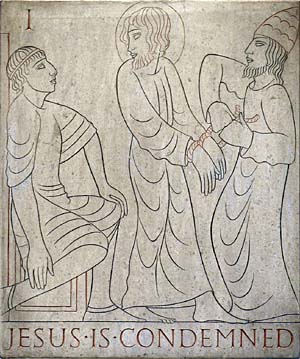
I Jesus is condemned to death
The very air that Pilate breathes, the voice
With which he speaks in judgment, all his powers
Of perception and discrimination, choice,
Decision, all his years, his days and hours,
His consciousness of self, his every sense,
Are given by this prisoner, freely given.
The man who stands there making no defence,
Is God. His hands are tied, His heart is open.
And he bears Pilate’s heart in his and feels
That crushing weight of wasted life. He lifts
It up in silent love. He lifts and heals.
He gives himself again with all his gifts
Into our hands. As Pilate turns away
A door swings open. This is judgment day.
--Malcolm Guite
"Halfway to poetry"
So wrote C.S. Lewis when describing “sentences that stick to the mind” from the prose of William Tyndale (c. 1494-1536).
What were these phrases? Here are two that Lewis singled out for special praise in his classic text, English Literature in the Sixteenth Century Excluding Drama —
We also hear echoes of Tyndale’s prose every day, throughout the English-speaking world.
Does that seem far-fetched? A simple presentation of Tyndale’s best-known phrases shows that it’s not. All are present in his celebrated translation of The New Testament, published in 1534. In Matthew, chapter five, we find “the salt of the earth.” Nine chapters later, in Matthew 16, we read of “the signs of the times.” Turn to Luke’s gospel, chapter twelve. There, we discover “eat, drink and be merry.” In Paul’s Epistle to the Romans, chapter 13, there is an admonition regarding “the powers that be.” And, in the Book of James, chapter 5, we encounter this memorable phrase: “the patience of Job.”
Our surprise only grows upon learning that Tyndale’s rendering of these phrases mark the first time they entered our language.

For people in the family of faith, the debt to Tyndale becomes
greater. Do we love lines of scripture such as “Let there be light,”
“seek, and ye shall find,” “fight the good fight of faith,” or “be not
weary in well doing”? They come to us from Tyndale.
Tyndale translated The New Testament by himself—a staggering thought when one considers how many committees have undertaken the task in subsequent centuries. His was a beautiful flowering of scholarship and artistry, the more poignant because his work of translating the entire Bible was cut short by his tragic martyrdom.
Movingly, it’s been said that Tyndale’s translation, timeless and beautiful, bears the hallmarks of a “solitary music.” Today, though we scarcely know it, we are his fortunate heirs. The English we speak owes a great and lasting debt to his scholarship and sacrifice. Many cadences of our literature issued from his pen. More than 475 years have passed since his death. Bless God, we may hear his music still.
--Kevin Belmonte
What were these phrases? Here are two that Lewis singled out for special praise in his classic text, English Literature in the Sixteenth Century Excluding Drama —
Who taught the eagles to spy out their prey? even so the children of God spy out their Father, that they might see and love again.Then followed a succinct tribute, as memorable as it was evocative. In the best of Tyndale’s prose, Lewis concluded, “we breathe mountain air.”
Where the spirit is, there is always summer.
We also hear echoes of Tyndale’s prose every day, throughout the English-speaking world.
Does that seem far-fetched? A simple presentation of Tyndale’s best-known phrases shows that it’s not. All are present in his celebrated translation of The New Testament, published in 1534. In Matthew, chapter five, we find “the salt of the earth.” Nine chapters later, in Matthew 16, we read of “the signs of the times.” Turn to Luke’s gospel, chapter twelve. There, we discover “eat, drink and be merry.” In Paul’s Epistle to the Romans, chapter 13, there is an admonition regarding “the powers that be.” And, in the Book of James, chapter 5, we encounter this memorable phrase: “the patience of Job.”
Our surprise only grows upon learning that Tyndale’s rendering of these phrases mark the first time they entered our language.
William Tyndale (from Marshall’s Dayspring bio 1883)
Tyndale translated The New Testament by himself—a staggering thought when one considers how many committees have undertaken the task in subsequent centuries. His was a beautiful flowering of scholarship and artistry, the more poignant because his work of translating the entire Bible was cut short by his tragic martyrdom.
Movingly, it’s been said that Tyndale’s translation, timeless and beautiful, bears the hallmarks of a “solitary music.” Today, though we scarcely know it, we are his fortunate heirs. The English we speak owes a great and lasting debt to his scholarship and sacrifice. Many cadences of our literature issued from his pen. More than 475 years have passed since his death. Bless God, we may hear his music still.
--Kevin Belmonte


But most days, if you're aware enough to give yourself a choice, you can choose to look differently at this fat, dead-eyed, over-made-up lady who just screamed at her kid in the checkout line. Maybe she's not usually like this. Maybe she's been up three straight nights holding the hand of a husband who is dying of bone cancer. Or maybe this very lady is the low-wage clerk at the motor vehicle department, who just yesterday helped your spouse resolve a horrific, infuriating, red-tape problem through some small act of bureaucratic kindness. Of course, none of this is likely, but it's also not impossible. It just depends what you want to consider. If you're automatically sure that you know what reality is, and you are operating on your default setting, then you, like me, probably won't consider possibilities that aren't annoying and miserable. But if you really learn how to pay attention, then you will know there are other options. It will actually be within your power to experience a crowded, hot, slow, consumer-hell type situation as not only meaningful, but sacred, on fire with the same force that made the stars: love, fellowship, the mystical oneness of all things deep down.
--from David Foster Wallace commencement speech
Saturday, March 30, 2013

The existence of consciousness is both one of the most familiar and one of the most astounding things about the world. No conception of the natural order that does not reveal it as something to be expected can aspire even to the outline of completeness. And if physical science, whatever it may have to say about the origin of life, leaves us necessarily in the dark about consciousness, that shows that it cannot provide the basic form of intelligibility for this world.
--Thomas Nagel

But then, one day, Moody and his brother were walking down the street of the town where they’d been sent to work. As Moody remembered—
"While we were walking down the street we saw an old man coming toward us, and my brother said, 'There is a man that will give you a cent. He gives every new boy that comes into this town a cent.' When the old man got opposite to us…my brother told him that I was a new boy in the town.
The old man, taking off my hat, placed his trembling hand on my head. He told me I had a Father in heaven.
It was a kind, simple act, but I feel the pressure of the old man’s hand upon my head today. You don’t know how much you may do by just speaking kindly.
Happiness

or the way it turns up like a prodigal
who comes back to the dust at your feet
having squandered a fortune far away.
And how can you not forgive?
You make a feast in honor of what
was lost, and take from its place the finest
garment, which you saved for an occasion
you could not imagine, and you weep night and day
to know that you were not abandoned,
that happiness saved its most extreme form
for you alone.
No, happiness is the uncle you never
knew about, who flies a single-engine plane
onto the grassy landing strip, hitchhikes
into town, and inquires at every door
until he finds you asleep midafternoon
as you so often are during the unmerciful
hours of your despair.
It comes to the monk in his cell.
It comes to the woman sweeping the street
with a birch broom, to the child
whose mother has passed out from drink.
It comes to the lover, to the dog chewing
a sock, to the pusher, to the basketmaker,
and to the clerk stacking cans of carrots
in the night.
It even comes to the boulder
in the perpetual shade of pine barrens,
to rain falling on the open sea,
to the wineglass, weary of holding wine.
--Jane Kenyon
Monday, March 4, 2013


The force of this hit me on a mild November evening when I was oppressed by woes; I prayed for a little relief and tried counting my blessings instead of my grievances. I've long known that a great secret of happiness is gratitude, but that didn't prepare me for what happened next.
As I munched a cheeseburger, I could hardly think of anything in my life that couldn't be seen as a gift from God. As one of the characters in Lear tells his father: "Thy life's a miracle." Of whom is that not true?
The more we reflect on the sheer oddity of our very existence and, in addition, of our eligibility for salvation, the deeper our gratitude must be. Amazing grace indeed! To call it astounding is to express the matter feebly. Why me? How on earth could I ever have deserved this, the promise of eternal joy?
And given all this, in comparison with which winning the greatest lottery in the world is just a minor fluke, how can I dare to sin again, or to be anything less than a saint for the rest of my life?
Yet I know that my own horrible spiritual habits will keep drawing me downward every hour. Like most men, or maybe more than most, I am my own worst enemy, constantly tempted to repay my Savior with my self-centered ingratitude. When I think of my sins, the debt of thanksgiving itself seems far too heavy to pay. No wonder He commands us to rejoice. It's by no means the easiest of our duties.
--Joe Sobran

To Linnell on her Birthday
The Blue Robe
By Wendell Berry
How joyful to be together, alone
as when we first were joined
in our little house by the river
long ago, except that now we know
each other, as we did not then;
and now instead of two stories fumbling
to meet, we belong to one story
that the two, joining, made. And now
we touch each other with the tenderness
of mortals, who know themselves:
how joyful to feel the heart quake
at the sight of a grandmother,
old friend in the morning light,
beautiful in her blue robe!

By Wendell Berry
How joyful to be together, alone
as when we first were joined
in our little house by the river
long ago, except that now we know
each other, as we did not then;
and now instead of two stories fumbling
to meet, we belong to one story
that the two, joining, made. And now
we touch each other with the tenderness
of mortals, who know themselves:
how joyful to feel the heart quake
at the sight of a grandmother,
old friend in the morning light,
beautiful in her blue robe!
Saturday, March 2, 2013

Friday, February 22, 2013
[If we are] enlightened by the Spirit of truth, we will then be able to pray for the increased ability to endure truth and not to be made angry by it (see 2 Ne. 28:28). In the depth of such a prayer, we may finally be led to that lonesome place where we suddenly see ourselves naked in all soberness. Gone are all the little lies of self-defense. We see ourselves in our vanities and false hopes for carnal security. We
are shocked to see our many deficiencies, our lack of gratitude for the smallest things. We are now at that sacred place that seemingly only a few have courage to enter, because this is that horrible place of unquenchable pain in fire and burning. . . . This is the place where suddenly the atonement of Christ is understood and embraced. . . .
With this fulfillment of love in our hearts, we will never be happy anymore just by being ourselves or living our own lives. We will not be satisfied until we have surrendered our lives into the arms of the loving Christ, and until He has become the doer of all our deeds and He has become the speaker of all our words.
--F. Enzio Busche
Friday, February 8, 2013
Tuesday, February 5, 2013

Monday, January 21, 2013

“Is it true, ma’am, that you have visions of Jesus,” asked the cleric.
“Yes,” the woman replied simply.
“Well, the next time you have a vision I want you to ask Jesus to tell you the sins that I confessed in my last confession.”
The woman was stunned. “Did I hear you right, bishop? You actually want me to ask Jesus to tell me the sins of your past?”
“Exactly. Please tell me if anything happens.”
Ten days later the woman notified her spiritual leader of a recent apparition. “Please come,” she said.
Within the hour the archbishop arrived. He trusted eye-to-eye contact. “You just told me on the telephone that you actually had a vision of Jesus. Did you do what I asked?”
“Yes, bishop, I asked Jesus to tell me the sins you confessed in your last confession.”
The bishop leaned forward with anticipation. His eyes narrowed. “What did Jesus say?”
She took his hand and gazed deep into his eyes. “Bishop, these are his exact words. I CAN’T REMEMBER.”
Tuesday, December 18, 2012
thought experiment
Would you select a small group of people who like ordering other people around, give them all the weapons, take all the weapons from everybody else, make everyone in society pay them no matter how effective or ineffective they were in doing what they were supposed to do and have them answer to the extent that they are answerable, not to you and your fellow members of society but to some other group of individuals who may or, more likely, may not have the same agenda that you do? Or would you do something else?
--Gerard Casey
Tuesday, November 20, 2012
Wednesday, November 7, 2012
Even in the more obvious of fraudulent past elections there was at least an attempt by the establishment to present a pageant of conflicting ideologies (George W. Bush vs. John Kerry comes to mind). There has always been the Democrat who pretends to be anti-war, or the Republican who pretends to be small government, or the Democrat who pretends to defend our right to privacy, and the Republican who pretends to be pro-2nd Amendment. But in 2012, even the theater of rhetoric has disappeared. Both primary party candidates seem to be sharing the same intestinal tract and the same teleprompter, and now, the average American is asking a new set of questions. They do not wonder how these men will change things for the better. Not at all. Instead, they wonder which one will do LESS DAMAGE while in office. This is the terrible reality we have come to understand in our society today. It is a sad awakening, but a necessary one.


Friday, November 2, 2012
The government consists of a gang of men exactly like you and me. They have, taking one with another, no special talent for the business of government; they have only a talent for getting and holding office. Their principal device to that end is to search out groups who pant and pine for something they can't get and to promise to give it to them. Nine times out of ten that promise is worth nothing. The tenth time is made good by looting A to satisfy B. In other words, government is a broker in pillage, and every election is sort of an advance auction sale of stolen goods.
--H.L. Mencken
Ninety-five years ago tomorrow, on November 2, 1917, British imperialism in Palestine began when Lord Balfour, the then British foreign secretary and former prime minister, sent a letter to Baron Rothschild, one of the leaders of the Zionist movement. This letter became known as the “Balfour Declaration”.
In that letter, Balfour promised British support for the Zionist programme of establishing a “national home for the Jewish people” in Palestine. This pledge of support was made without consulting the indigenous Christian and Muslim inhabitants of Palestine, the Palestinian people. And it was made before British troops had even conquered the land.
Balfour, on behalf of Britain, promised Palestine – over which Britain had no legal right – to a people who did not even live there (of the very small community of Palestinian Jews in Palestine in 1917, very few were Zionists). And he did so with the worst of intentions: to discourage Jewish immigration to Britain. No wonder Lord Montagu, the only Jewish member of the Cabinet, opposed the declaration.
--(London) Telegraph
“The meaning of life is not a solution to a problem, but a matter of living in a certain way. It is not metaphysical, but ethical. It is not something separate from life, but what makes it worth living - which is to say, a certain quality, depth, abundance and intensity of life. In this sense, the meaning of life is life itself, seen in a certain way. Meaning-of-life merchants generally feel let down by such a claim, since it does not seem mysterious and majestic enough… It is just this kind of bathos that Matthew sets up in his gospel, where he presents the Son of Man returning in glory surrounded by angels for the Last Judgement. Despite this off-the-peg cosmic imagery, salvation turns out to be an embarrassingly prosaic affair - a matter of feeding the hungry, giving drink to the thirsty, welcoming the stranger, and visiting the imprisoned. It has no ‘religious’ glamour or aura whatsoever. Anybody can do it… Eternity lies not in a grain of sand but in a glass of water. The cosmos revolves on comforting the sick. When you act in this way, you are sharing in the love which built the stars. To live in this way is not just to have life, but to have it in abundance.”
—The Meaning of Life: A Very Short Introduction, Terry Eagleton, 2007)
Monday, October 15, 2012
Tuesday, September 18, 2012
Thomas Szasz RIP
Some good quotes from the good doctor:
*People dream of making the virtuous powerful, so they can depend on them. Since they cannot do that, people choose to make the powerful virtuous, glorifying in becoming victimized by them.
*Clear thinking requires courage rather than intelligence.
*The self is not something one finds, it is something one creates.
*The greatest analgesic, soporific, stimulant, tranquilizer, narcotic, and to some extent even antibiotic –in short, the closest thing to a genuine panacea –known to medical science is work.
Thursday, May 24, 2012
can't have no scissorhands around here
 The high-school Mitt Romney who, it is alleged, helped to forcibly restrain and cut the hair of a classmate must be distinguished from the modern GOP presidential candidate Mitt Romney. Had he acted as Delilah towards some hapless teenager while serving as governor of Massachusetts or, worse yet, while campaigning for Maximum Leader, it would have caused voters some discomfort. How unpresidential, after all! However, bomb and torture innocent persons abroad; assassinate and imprison, without trial, Americans; and loot taxpayers' money for the benefit of his corporate cronies: now, that’s the vision we can all embrace.
Monday, May 14, 2012

Friday, May 4, 2012
 For some years I have been haunted by a story of [writer William Dean]Howells and that most civilized of all our presidents, James A. Garfield. In the early 1870s Howells and his father paid a visit to Garfield. As they sat on Garfield’s veranda, young Howells began to talk about poetry and about the poets that he had met in Boston and New York. Suddenly, Garfield told him to stop. Then Garfield went to the edge of the veranda and shouted to his Ohio neighbors, ‘Come over here! He’s telling about Holmes, and Longfellow, and Lowell, and Whittier!’ So the neighbors gathered around in the dusk; then Garfield said to Howells, ‘Now go on.’
Today we take it for granted that no living president will ever have heard the name of any living poet. This is not, necessarily, an unbearable loss. But it is unbearable to have lost those Ohio neighbors who actually read books of poetry and wanted to know about the poets.
--Bill Kauffman
For some years I have been haunted by a story of [writer William Dean]Howells and that most civilized of all our presidents, James A. Garfield. In the early 1870s Howells and his father paid a visit to Garfield. As they sat on Garfield’s veranda, young Howells began to talk about poetry and about the poets that he had met in Boston and New York. Suddenly, Garfield told him to stop. Then Garfield went to the edge of the veranda and shouted to his Ohio neighbors, ‘Come over here! He’s telling about Holmes, and Longfellow, and Lowell, and Whittier!’ So the neighbors gathered around in the dusk; then Garfield said to Howells, ‘Now go on.’
Today we take it for granted that no living president will ever have heard the name of any living poet. This is not, necessarily, an unbearable loss. But it is unbearable to have lost those Ohio neighbors who actually read books of poetry and wanted to know about the poets.
--Bill Kauffman

sins of the mothers
Anecdote about Tennessee Williams, courtesy of Gore Vidal
 Of a dinner with Williams and his magnificently termagant mother:
Tennessee clears his throat again. ‘Mother, eat your shrimp.’
‘Why,’ counters Miss Edwina, ‘do you keep making that funny sound in your throat?’
‘Because, Mother, when you destroy someone’s life you must expect certain nervous disabilities.’
Of a dinner with Williams and his magnificently termagant mother:
Tennessee clears his throat again. ‘Mother, eat your shrimp.’
‘Why,’ counters Miss Edwina, ‘do you keep making that funny sound in your throat?’
‘Because, Mother, when you destroy someone’s life you must expect certain nervous disabilities.’

Monday, April 30, 2012
You cannot know a politician's heart
[Let us not forget] that deceit is the basis of all politics. I remember before the Gulf War, I was talking to a Baptist seminarian who couldn't believe that Bush of Arabia had anything but the best interests of the United States at heart in preparing to make war. "I think he's a decent man," he said. On what basis? What we see or hear on television? I'd sooner trust Lynda Carter's endorsements of contact lenses.
Yet any vote cast in an election presupposes that the voter has some idea of what kind of person the candidate is. Even when local officials are elected from fairly large communities, voters sometimes think of them as neighbors, and think they know them and can trust them. How often it's just wishful thinking, indeed vanity. How nice it would be to personally know someone important. Not to try to get a job from him. Not to get a favor from him. But merely for the self-deluding frisson of being able to say, "Yeah, I know him. He went to my church. He's a good guy."
The desire to believe good of someone is not the Christian virtue of charity. Charity is desiring someone's good. It is never in conflict with truth. Not so the desire to believe good of someone, which normally functions as a reverse filter, letting only muddy thoughts pass through and blocking clear ones. And when the desire becomes the positive act of belief itself — as it so easily does — then have we subverted our rational faculties. It's a vanity to believe something without evidence — as though one's faculties are more penetrating than, in the nature of things, they can be. A little like the vanity of name-dropping.
[I]n 1932 the free-market candidate was Franklin Roosevelt. In 1964, the anti-war candidate was Lyndon Johnson. On what basis could people who didn't know [a candidate] claim to know what he would do? What we could be sure of was that issues would emerge, complicated incidents would occur, that the next president would have to address — questions that, in early 1992, we could not imagine. To vote for anyone was nevertheless to claim to have reason to believe that he would do the right thing. And that kind of evidence hardly anyone could ever have, for hardly anyone in the country would ever know any candidate well enough to have that kind of confidence.
To imagine that you can know anything about a man from his speeches, the purpose of which is to win your trust, is just cognitive vanity. In real life, we never trust someone on the basis of what he says or does explicitly to win our trust. Only in politics are we expected to be such fools.
To believe more than evidence gives us is a temptation like many others. But truth is more important than our vanity. Bad enough that the eternal beatitude of our souls is jeopardized when we corrupt our cognitive faculties in favor of the passing pleasure of vanity. But the temporal, political consequences of our self-deceptions are no small potatoes, either.
--Ronn Neff


One of the most famous social science experiments is Stanley Milgram's Obedience to Authority studies at Yale. Subjects were asked to administer ascending quantities of electrical shock to people each time they answered a question incorrectly. Those receiving the shock were hired actors, not really being shocked, but the subjects didn't know that.
The intensity of shock began at 15 volts and rose in 15-volt increments up to 300 volts. The subjects heard screams, pleas to stop, complaints of heart pains and then silence – yet many of them continued to the end. How many?
Two-thirds of participants administered the full range of shock, simply because the person in authority – a man with a white coat – would say, "The experiment requires that you continue."
This is very scary, of course, but there's more to the story: In a little known but vitally important detail in these experiments, those who witnessed another person refuse to comply with the authority were dramatically more likely to refuse to comply themselves. In this case only 10% obeyed the orders of the authority.
The power of a positive example represents a huge potential for good.
Monday, February 20, 2012

Tuesday, February 7, 2012

For many years I worked in palliative care. My patients were those who had gone home to die. Some incredibly special times were shared. I was with them for the last three to twelve weeks of their lives.
People grow a lot when they are faced with their own mortality. I learnt never to underestimate someone's capacity for growth. Some changes were phenomenal. Each experienced a variety of emotions, as expected, denial, fear, anger, remorse, more denial and eventually acceptance. Every single patient found their peace before they departed though, every one of them.
When questioned about any regrets they had or anything they would do differently, common themes surfaced again and again. Here are the most common five:
1. I wish I'd had the courage to live a life true to myself, not the life others expected of me.
This was the most common regret of all. When people realise that their life is almost over and look back clearly on it, it is easy to see how many dreams have gone unfulfilled. Most people had not honoured even a half of their dreams and had to die knowing that it was due to choices they had made, or not made.
It is very important to try and honour at least some of your dreams along the way. From the moment that you lose your health, it is too late. Health brings a freedom very few realise, until they no longer have it.
2. I wish I didn't work so hard.
This came from every male patient that I nursed. They missed their children's youth and their partner's companionship. Women also spoke of this regret. But as most were from an older generation, many of the female patients had not been breadwinners. All of the men I nursed deeply regretted spending so much of their lives on the treadmill of a work existence.
By simplifying your lifestyle and making conscious choices along the way, it is possible to not need the income that you think you do. And by creating more space in your life, you become happier and more open to new opportunities, ones more suited to your new lifestyle.
3. I wish I'd had the courage to express my feelings.
Many people suppressed their feelings in order to keep peace with others. As a result, they settled for a mediocre existence and never became who they were truly capable of becoming. Many developed illnesses relating to the bitterness and resentment they carried as a result.
We cannot control the reactions of others. However, although people may initially react when you change the way you are by speaking honestly, in the end it raises the relationship to a whole new and healthier level. Either that or it releases the unhealthy relationship from your life. Either way, you win.
4. I wish I had stayed in touch with my friends.
Often they would not truly realise the full benefits of old friends until their dying weeks and it was not always possible to track them down. Many had become so caught up in their own lives that they had let golden friendships slip by over the years. There were many deep regrets about not giving friendships the time and effort that they deserved. Everyone misses their friends when they are dying.
It is common for anyone in a busy lifestyle to let friendships slip. But when you are faced with your approaching death, the physical details of life fall away. People do want to get their financial affairs in order if possible. But it is not money or status that holds the true importance for them. They want to get things in order more for the benefit of those they love. Usually though, they are too ill and weary to ever manage this task. It is all comes down to love and relationships in the end. That is all that remains in the final weeks, love and relationships.
5. I wish that I had let myself be happier.
This is a surprisingly common one. Many did not realise until the end that happiness is a choice. They had stayed stuck in old patterns and habits. The so-called 'comfort' of familiarity overflowed into their emotions, as well as their physical lives. Fear of change had them pretending to others, and to their selves, that they were content. When deep within, they longed to laugh properly and have silliness in their life again.
When you are on your deathbed, what others think of you is a long way from your mind. How wonderful to be able to let go and smile again, long before you are dying.
--Bronnie Ware
Friday, February 3, 2012

To field a ground ball must be considered a generous act and an act of comprehension. One moves not against the ball but with it. Bad fielders stab at the ball like an enemy. This is antagonism. The true fielder lets the path of the ball become his own path, thereby comprehending the ball and dissipating the self, which is the source of all suffering and poor defense.
--Aparicio Rodriguez, The Art of Fielding
Tuesday, January 24, 2012
I am trying to restrain my contempt for people claiming to be religious who are perfectly prepared to turn the country over to another warmongering, corrupt, influence-peddling, spend-us-into-oblivion, Wall Street stooge — who, on top of it all, holds them in contempt.
I am not always successful in this, however. So I admit I liked this:

--Tom Woods
I am not always successful in this, however. So I admit I liked this:

--Tom Woods
Friday, January 13, 2012

We recently saw the impressive movie, Of Gods and Men, about a small group of monks in Algeria during the civil war. The movies closes with a portion of a letter from one of them:
Should it ever befall me, and it could happen today, to be a victim of the terrorism swallowing up all foreigners here, I would like my community, my church, my family, to remember that my life was given to God and to this country.
The Unique Master of all life was no stranger to this brutal departure. And that my death is the same as so many other violent ones, consigned to the apathy of oblivion.
I’ve lived enough to know that I am complicit in the evil that, alas, prevails over the world and the evil that will smite me blindly. I could never desire such a death. I could never feel gladdened that these people I love be accused randomly of my murder.
I know the contempt felt for the people here, indiscriminately. And I know how Islam is distorted by a certain Islamism. This country, and Islam, for me are something different. They’re a body and a soul.
My death, of course, will quickly vindicate those who called me naive, or idealistic, but they must know that I will be freed of a burning curiosity and, God willing, will immerse my gaze in the Father’s and contemplate with him his children of Islam as he sees them.
This thank-you which encompasses my entire life includes you, of course, friends of yesterday and today, and you too, friend of the last minute, who knew not what you were doing.
Yes, to you as well I address this thank-you and this farewell which you envisaged. May we meet again, happy thieves in Paradise, if it pleases God, the Father of us both. Amen.
Friday, December 30, 2011
Would you sacrifice your firstborn son to establish a democracy in country that had a dictatorship? How about giving up your son to effect a regime change? What about exchanging your son to end the oppression of minorities? How about trading your son in return for a country holding elections?
I don’t know of any American mother or father that would do such a thing. I wouldn’t give a finger from one of my sons to do any of these things. Some Americans, however, wouldn’t mind it if some other American’s son came back from some foreign war in a box with only a finger that was recognizable – just as long as it wasn’t their son.
The next time some armchair warrior, some warvangelical, some member of Congress, some reich-wing nationalist, some bloodthirsty conservative, some warmongering Republican, some red-state fascist, some neocon, or some theocon beats the drums for war – like they are doing regarding Iran right now – tell him to put his son in uniform, put him on the first plane overseas, and tell his son what a noble cause it is that he is being sent to die for. Let him tell his son how much his death will be worth it. And if he doesn’t think it worth the death of his son, then it is not worth the death of any other American’s son either.
--Laurence Vance
I don’t know of any American mother or father that would do such a thing. I wouldn’t give a finger from one of my sons to do any of these things. Some Americans, however, wouldn’t mind it if some other American’s son came back from some foreign war in a box with only a finger that was recognizable – just as long as it wasn’t their son.
The next time some armchair warrior, some warvangelical, some member of Congress, some reich-wing nationalist, some bloodthirsty conservative, some warmongering Republican, some red-state fascist, some neocon, or some theocon beats the drums for war – like they are doing regarding Iran right now – tell him to put his son in uniform, put him on the first plane overseas, and tell his son what a noble cause it is that he is being sent to die for. Let him tell his son how much his death will be worth it. And if he doesn’t think it worth the death of his son, then it is not worth the death of any other American’s son either.
--Laurence Vance
Subscribe to:
Posts (Atom)


